Buying guide / Updated July 2026
Best Ukulele for Beginners: how to pick your first uke
Four strings, one afternoon, and a decision most people get wrong. Here is what actually matters.
The best ukulele for beginners is almost always a mahogany soprano or concert model with geared tuners, priced between $60 and $130, from a brand like Kala, Cordoba, Donner or Enya. Size and hardware matter far more than the logo on the headstock. This guide explains how to choose your size, what separates a real instrument from a toy, and five starter ukuleles worth your money.
Best ukulele for beginners at a glance
| Ukulele | Size | Typical price | Best for |
|---|---|---|---|
| Kala KA-15S | Soprano | $70 to $85 | Most first-time buyers |
| Cordoba 15CM | Concert | $120 to $140 | Adults with larger hands |
| Donner DUC-1 | Concert | $60 to $75 | Best complete bundle |
| Enya Nova U Mini | Soprano | $70 to $90 | Kids, travel, humid climates |
| Makala Dolphin | Soprano | $45 to $60 | Tight budgets and classrooms |
Prices move often. Check current listings before you buy.
What size ukulele is best for a beginner?
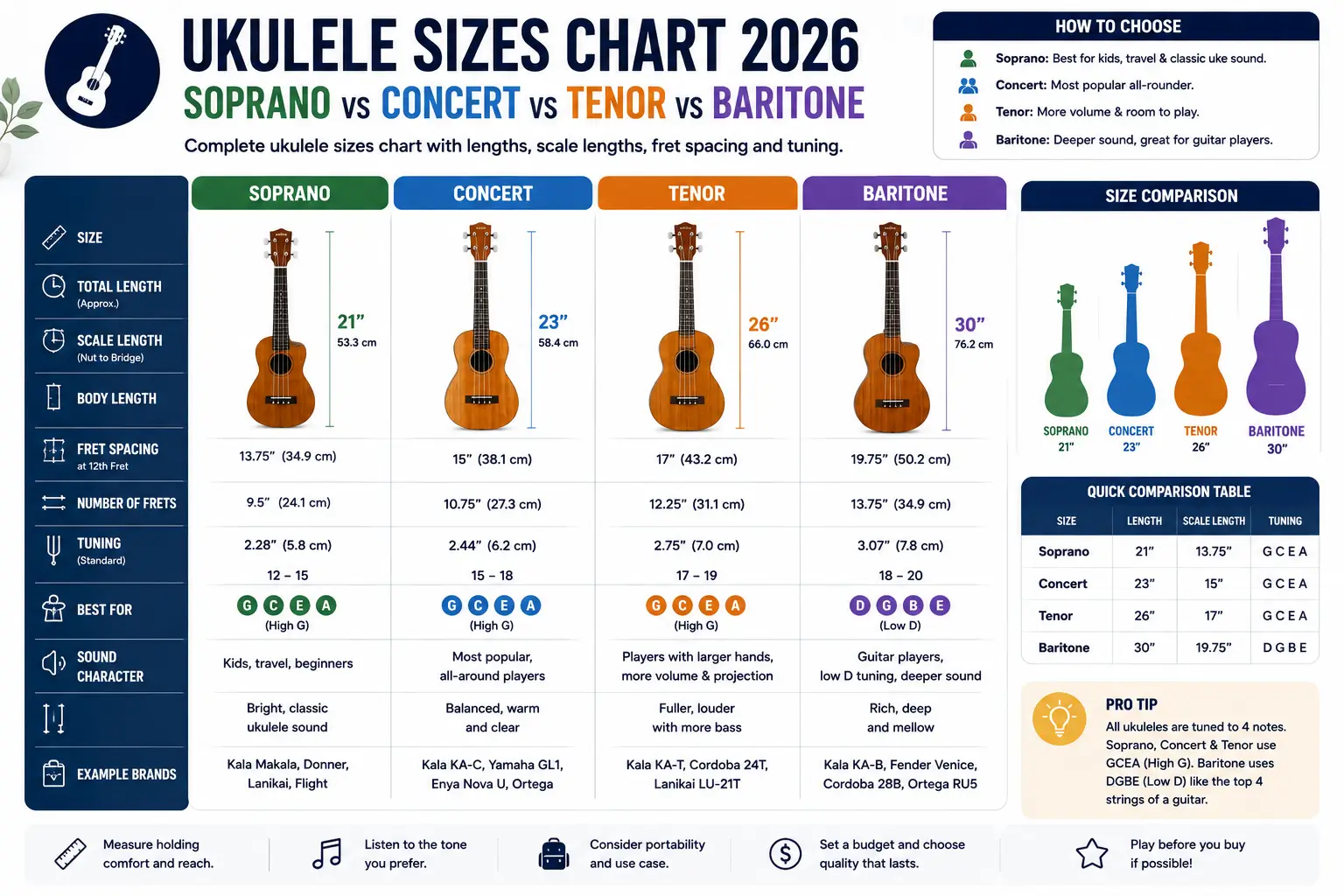
The ukulele comes in four common sizes. Three of them share the same tuning, so the choice is mostly about comfort, not sound.
Drawn to scale
Bar length matches real body length, so you can see the difference instead of reading it.
Soprano (about 21 inches)
This is the original size, descended from the Portuguese machete that sailors from Madeira brought to Hawaii in the 1880s. It has a scale length near 13.6 inches and a bright, jangly voice. Frets sit close together, which suits children and smaller hands but can feel cramped for adult fingers.
Concert (about 23 inches)
The concert adds roughly two inches and a 15 inch scale. That extra fret spacing is the single biggest comfort upgrade for adult beginners, and the larger body gives a warmer, louder tone. If you are an adult and unsure, this is the safe pick.
Tenor (about 26 inches)
A 17 inch scale and a bigger body produce a deeper, richer sound. Tenors are popular with performers such as Jake Shimabukuro. They cost more and are heavier, so most beginners do not need one on day one.
Baritone (about 30 inches)
Skip this one as a first ukulele. The baritone is tuned D-G-B-E instead of G-C-E-A, so most beginner chord charts, apps and YouTube lessons will not match what you are holding.
| Size | Total length | Scale length | Tuning | Best for |
|---|---|---|---|---|
| Soprano | ~21 in | ~13.6 in | G-C-E-A | Kids, small hands, travel |
| Concert | ~23 in | ~15 in | G-C-E-A | Most adult beginners |
| Tenor | ~26 in | ~17 in | G-C-E-A | Big hands, fingerpicking |
| Baritone | ~30 in | ~19 in | D-G-B-E | Guitar players only |
The hand test most buying guides skip
Guides tell you concert size suits adults, but nobody explains how to check. Here is a simple test you can do right now.
Measure your index finger from the base knuckle to the tip:
- Under 7 cm: a soprano will feel comfortable.
- 7 cm to 8 cm: either size works, and concert is the safer choice.
- Over 8 cm: go concert or tenor. On a soprano your fingers will mute the strings next to the one you are fretting.
This matters because most beginners who give up blame themselves for buzzing chords. Often the instrument was simply too small for their hands.
Five things that matter more than the brand name
1. Geared tuners, not friction pegs
This is the most important spec on any beginner ukulele. Friction tuners are plain pegs held by pressure alone, and they slip constantly. Geared tuners use a worm gear, usually at a 14:1 ratio or better, and hold pitch reliably. Every uke on our list uses geared tuners.
2. Action height at the 12th fret
Action is the gap between string and fret. At the 12th fret it should measure roughly 2.5 mm to 3 mm on the first string. Higher than that and chords hurt. This is the number a shop technician adjusts during a setup.
3. The strings in the box
Cheap ukuleles ship with generic nylon that sounds dull and goes flat. Quality brands fit Aquila Nylgut or D’Addario strings. If yours does not, a $10 set of Aquilas is the single best upgrade you can make.
4. Laminate is fine, and often better
Reviews praise solid wood tops, but for a first ukulele laminate is the smarter choice. Laminated mahogany or sapele resists cracking when humidity swings, survives being carried around, and costs less. Save solid koa or spruce for your second instrument.
5. What is actually in the bundle
A useful starter kit includes a gig bag, a clip-on tuner, a strap and spare strings. Picks are optional, since the ukulele is traditionally played with the fingers. If a bundle is padded with a dozen throwaway items, the money went into packaging instead of the instrument.
Five picks worth your money
Best overall
Kala KA-15S
The KA-15S is the model most ukulele teachers name first. It uses laminated mahogany, a satin finish that does not stick to sweaty hands, geared tuners and a walnut fingerboard. Factory setup is consistent from unit to unit, which is rare at this price.
Best for adults
Cordoba 15CM
Cordoba built its reputation on classical guitars, and that care shows here. The 15CM is a concert-size mahogany uke with an abalone rosette, ivoroid binding and chrome pearl-button tuners. The longer scale gives adult fingers real room.
Best bundle
Donner DUC-1
The DUC-1 is a concert ukulele with a mahogany body and a genuinely useful kit: bag, tuner, strap, spare strings and cloth. For someone who is not yet sure they will stick with it, this is the lowest risk entry point that still plays like a real instrument.
Best for kids and travel
Enya Nova U Mini
The Nova U is molded from a carbon fiber and polycarbonate composite instead of wood. It shrugs off heat, humidity and being dropped, which makes it ideal for children, beach trips and tropical climates where wooden instruments crack. Tone is brighter and more compressed than wood.
Best under $60
Makala Dolphin
Made by Kala’s budget line, the Dolphin has been the classroom standard for years. The plastic dolphin bridge looks like a gimmick but it works, and the instrument plays far better than anything else at the price.
How much should you spend on your first ukulele?
| Budget | What you get | Our view |
|---|---|---|
| Under $30 | Souvenir instruments, unstable tuning | Avoid |
| $40 to $60 | Basic laminate, geared tuners, simple kit | Fine for kids |
| $60 to $130 | Proper mahogany body, reliable setup | The sweet spot |
| $130 to $300 | Solid tops, bone nut and saddle, electronics | Buy later, not first |
Spending $100 on one good ukulele beats spending $40 on a poor one and then $60 fixing it.
Your new ukulele will not stay in tune, and that is normal
Nylon strings stretch. For the first five to ten days, a brand new ukulele will drift flat after every session, sometimes within minutes. This is physics, not a fault, and it happens on a $500 instrument too.
Tune it, play it, tune it again. Gently stretching each string by hand speeds the process up. After roughly a week the strings settle and hold pitch normally. Many beginners return a perfectly good ukulele during this window because nobody warned them.
Mistakes that make beginners quit
- Buying a baritone by accident and finding no chord chart matches.
- Choosing soprano as a tall adult and blaming your fingers for buzzing.
- Buying the cheapest option available and fighting the action every day.
- Skipping a clip-on tuner. An out-of-tune uke sounds wrong no matter how well you play.
- Leaving it in a case. An instrument on a wall hook gets played ten times more often.
Frequently asked questions
Is soprano or concert better for a beginner?
Concert is better for most adult beginners because the longer scale gives fingers more room between frets. Soprano suits children, players with small hands and anyone who wants the traditional bright Hawaiian tone. Both use the same G-C-E-A tuning, so lessons and chord charts work for either.
How much should a beginner spend on a ukulele?
Between $60 and $130 for an adult, and $45 to $70 for a child. That range buys geared tuners, a properly finished fretboard and a consistent factory setup. Below $30 you are usually buying a souvenir rather than an instrument.
Is the ukulele easier to learn than guitar?
Yes, for most people. It has four nylon strings instead of six steel ones, so chords need fewer fingers and press more softly. Many beginners play a recognizable song within their first day.
What is the best ukulele brand for beginners?
Kala, Cordoba, Donner, Enya, Ohana, Flight and Lanikai all make dependable entry-level instruments. Kala is the most widely recommended by teachers because its factory setup is consistent across units.
How do you tune a ukulele?
Standard tuning is G-C-E-A. The G string is tuned higher than the C, which is called re-entrant tuning and gives the ukulele its cheerful sound. A clip-on chromatic tuner attached to the headstock is the easiest and most accurate method.
Does the wood change how a ukulele sounds?
Yes. Mahogany and sapele give a warm, mellow tone that suits the bright ukulele voice. Maple and spruce sound brighter and louder. Koa, the traditional Hawaiian wood, sits in between but costs considerably more.
Should a beginner buy a solid wood ukulele?
Usually no. Solid wood sounds better but cracks when humidity changes and needs more care. A laminated mahogany body is tougher, cheaper and perfectly good for learning.
How long does it take to learn the ukulele?
Most people play a simple two-chord song within a day and four or five open chords within two weeks. Smooth chord changes at song tempo generally take one to three months of short daily practice.
Final thoughts
The best ukulele for beginners is the one that is comfortable in your hands and holds its tuning long enough for you to enjoy playing it. Pick your size first, insist on geared tuners, budget around $100, and accept that the first week of tuning drift is normal.
The ukulele earned its place in music history because it is welcoming. From the Hawaiian court musicians of the 1880s to Israel Kamakawiwo’ole, its appeal has always been that anyone can pick one up and make music quickly. Choose a decent instrument, keep it somewhere visible, and that is exactly what will happen.
Not sure about sizing yet? Read our complete ukulele sizes chart, then learn how to tune a ukulele and try our first beginner chords. For background on how the instrument traveled from Madeira to Hawaii, see the Wikipedia entry on the ukulele.

Team Unicode to Krutidev builds and maintains the Hindi typography tools on this site, including this converter. He works with Devanagari font encodings, Remington keyboard layouts, and legacy to Unicode migration for typists and DTP professionals across India.